
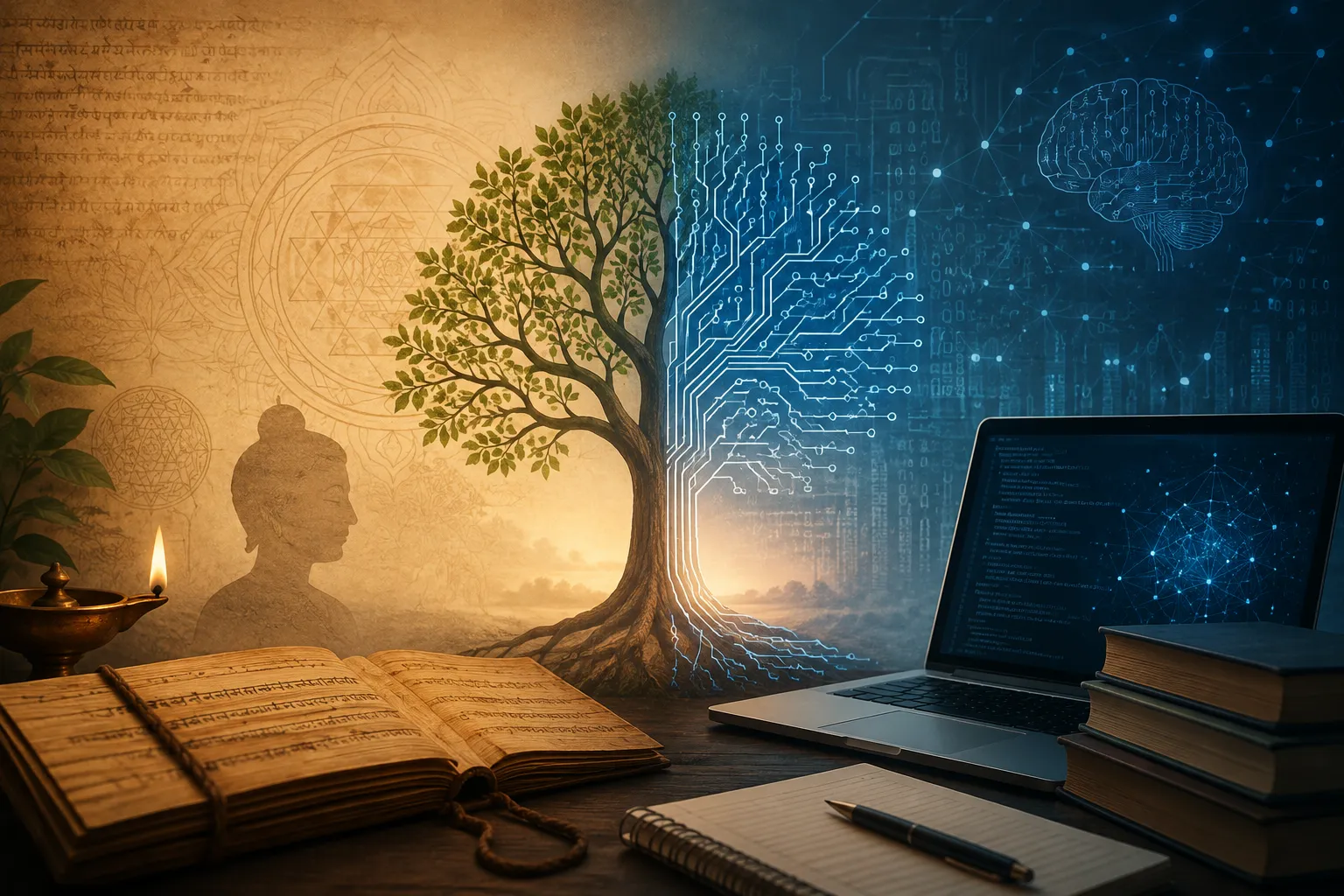
As a teacher of Computer Science for over three decades, I have spent much of my professional life engaging with algorithms, programming, computational thinking, software systems, databases, and, Artificial Intelligence. Like all in the field for this long, I have witnessed technology evolve at an unprecedented pace, transforming the way we learn, work, communicate, and solve problems.
Alongside this professional journey, I have nurtured a long-standing interest in various aspects of Indian Knowledge Systems (IKS), Dharma, dharmic texts, languages, ancient Indian history and knowledge traditions. For many years, these remained parallel interests—one, belonging to my academic profession and the other to my personal intellectual curiosity.
Recently, however, I have begun to realize that these two domains may have more in common than I had initially thought. This realization has inspired me to explore the intersection of Computer Science and Indian Knowledge Systems.
When people hear the terms “Computer Science” and “Indian Knowledge Systems” in the same sentence, they often assume that the objective is to prove that ancient India possessed modern technologies or to draw direct equivalences between ancient concepts and contemporary computing. That is not my intention. I believe both Computer Science and Indian Knowledge Systems deserve to be studied with intellectual honesty and academic rigor.
My interest lies in understanding how Indian traditions have approached questions related to knowledge organization, language, reasoning, memory, learning, cognition, abstraction, and systematic thinking. These are themes that are central to both computing and many Indian intellectual traditions.
One of the most outstanding aspects of Computer Science is its reliance on structure. Whether we are designing algorithms, building software systems, creating databases, or developing AI models, we constantly seek ways to organize complexity through rules, abstractions, and representations.
As I began learning about Indian Knowledge Systems, I was intrigued by the extent to which ancient scholars engaged in systematic methods of organizing and transmitting knowledge. Sophisticated traditions emerged around grammar, logic, mathematics, debate, education, and memory. While the contexts were vastly different, the emphasis on structure, precision, and systematic inquiry feels surprisingly familiar to someone educated in computing.
My recent acquaintance with complexities of Sanskrit language has opened one more intriguing avenue of study. Language is getting more and more central to modern computing. Search engines, conversational agents, machine translation systems, and large language models all depend on understanding and processing language. As I learn more about Sanskrit and its grammatical traditions, I find myself asking stimulating questions:
- How were linguistic structures conceptualized?
- What principles governed the generation and interpretation of language?
- What can highly structured linguistic systems teach us about representation and communication?
These questions are not merely historical; they resonate with contemporary discussions in computational linguistics and natural language processing.
Computer Science is fundamentally concerned with logic and reasoning. From Boolean algebra and algorithms to artificial intelligence and decision systems, reasoning forms the foundation of much of our discipline. Indian intellectual traditions also devoted significant attention to questions of reasoning, debate, evidence, and knowledge validation. Exploring these traditions has been an encouragement to think more deeply about how humans construct, justify, and communicate knowledge. While modern computing and classical philosophical traditions belong to different periods and serve different purposes, examining them together can enrich our understanding of both.
As an educator, I am particularly interested in knowing how knowledge is transmitted across generations. Long before digital technologies, complex systems of knowledge were preserved through carefully designed educational practices. Understanding these approaches may provide valuable perspectives for contemporary education, especially at a time when technology is reshaping learning environments. The goal is not to romanticize the past or reject the present. Rather, it is to explore how enduring educational insights can complement modern pedagogical approaches. At this stage, my exploration is driven more by curiosity than by conclusions.
I am a learner, a reader, and an explorer making an attempt to understand meaningful connections between different domains of knowledge. The possibility of discovering thoughtful intersections between seemingly distant disciplines excites me.
Computer Science has taught me the value of abstraction, structure, and problem-solving. Indian Knowledge Systems offer rich perspectives on language, reasoning, learning, and human understanding. Bringing these conversations together may help us think more deeply about both technology and ourselves. It is the structural resonance between the two that inspires me. When you place a classical Indian knowledge system next to its modern computational counterpart, each one illuminates the other. The ancient system reveals the essential idea beneath the modern jargon. The modern system reveals how far the ancient insight can be taken with new tools.
As I continue this journey, I hope to share reflections from my readings, classroom experiences, and interdisciplinary explorations. I look forward to engaging with fellow educators, researchers, students, and curious minds who are interested in exploring these fascinating intersections.