
Since the announcement of the National Education Policy 2020 there has seen a remarkable surge of activity around Indian Knowledge Systems in academic institutions across the country. Syllabus committees have been constituted, course outlines have been drafted, and credit structures are discussed. Conferences have been organized, and experts brought together for meaningful discussions. This drive is genuine and welcome as it indicates acknowledgment, long overdue in Indian formal education, that the knowledge traditions of India deserve a serious and persistent place in academics.
The volume of this buzz, however, should not be mistaken for its depth. Much of what is being designed is curriculum in the routine managerial sense including lists of topics to be included, arrangement of units, evaluation patterns, credit distribution etc.. These discussions are essential, but they are tools, and a tool derives its value fully from the hand that uses or applies it.
The bigger problem with the current dialogue on IKS curriculum design is that it is, almost entirely, a conversation about content and structure rather than about the human being who will stand in the classroom and bring that content to life. Committees deliberate over whether Nyaya epistemology should be taught first or should follow a study of classical Indian mathematics. Task forces debate the proper balance between recorded texts and contemporary application. These are not trivial questions, but they are secondary ones.
A curriculum that focuses on Charaka and Panini and the Arthashastra, taught by a faculty member who has not genuinely grappled with these traditions, will produce students who have come across names and frameworks without being intellectually changed by them.
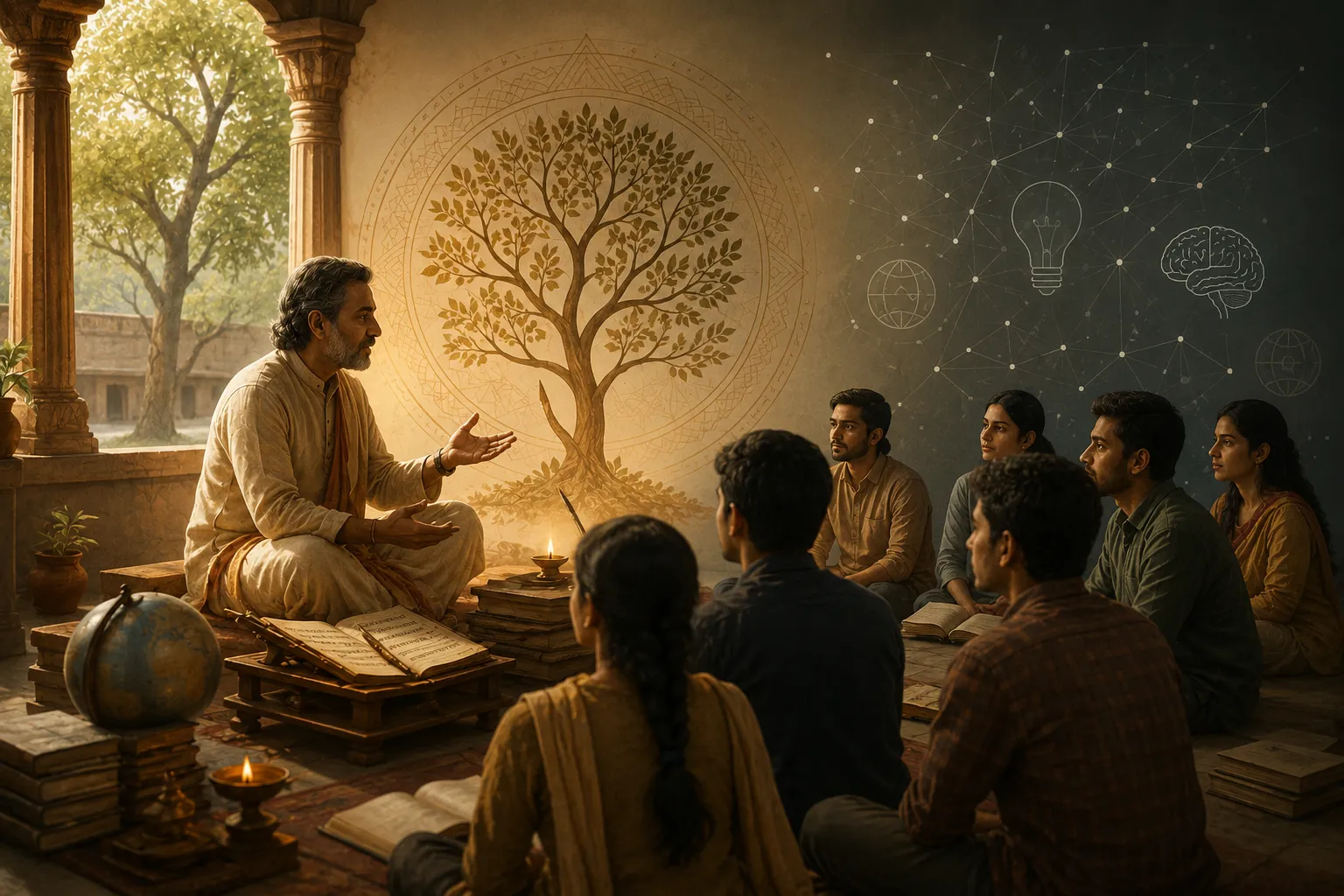
The NEP’s vision for IKS, that it should restructure how Indian graduates think, not merely what they know, cannot be realized through curriculum design alone. It requires a prior and more demanding investment in the development of the teacher. The central challenge of integrating Indian Knowledge Systems (IKS) into higher education thus, is not curriculum design, it is teacher formation. A well-designed syllabus means little without a teacher who has genuinely engaged with IKS as a living intellectual tradition.
An ideal IKS teacher must symbolize an inquisitive temperament, as someone who approaches IKS through open questions rather than settled answers. An IKS teacher must have cross-traditional intellectual foundation i.e. grounding in Indian philosophy, language sensitivity, history of knowledge, and epistemic humility, courage to resist two temptations, one, romanticisation, which turns IKS into mythology, and two, dismissiveness, which treats it as pre-scientific myth, the capacity to bridge technology, ethics, culture, and reasoning without flattening them, and above all, sustained intellectual curiosity as a talent.
The IKS teachers therefore need a well-structured training which could have the following phases: a foundational immersion programme, philosophical inquiry workshops, language sensitization, cross-disciplinary learning communities, mentorship with practitioner-scholars, inquiry-based pedagogy training, and ongoing reflective practice.
Even the best development programmes will fail without supportive institutional environments, reward structures that value depth, assessment frameworks that accommodate uncertainty, and leadership that understands the difference between IKS as compliance exercise and IKS as genuine educational transformation.
The implementation of the IKS integration exercise will therefore have to be done very cautiously, while considering that the teacher is not the vehicle for the curriculum, the teacher is a constituent of the curriculum.